
- 601 results
A Dark Matter Journey from Particle Physics to Modern Cosmology.
The purpose of these lectures is to provide the basis on modern theoretical cosmology.
The theory of groups and their representations is a central topic which studies symmetries in various contexts occurring in pure or applied mathematics as well as in other sciences, most notably in physics.
How do you prepare your admission to the Ecole Normale Supérieure?
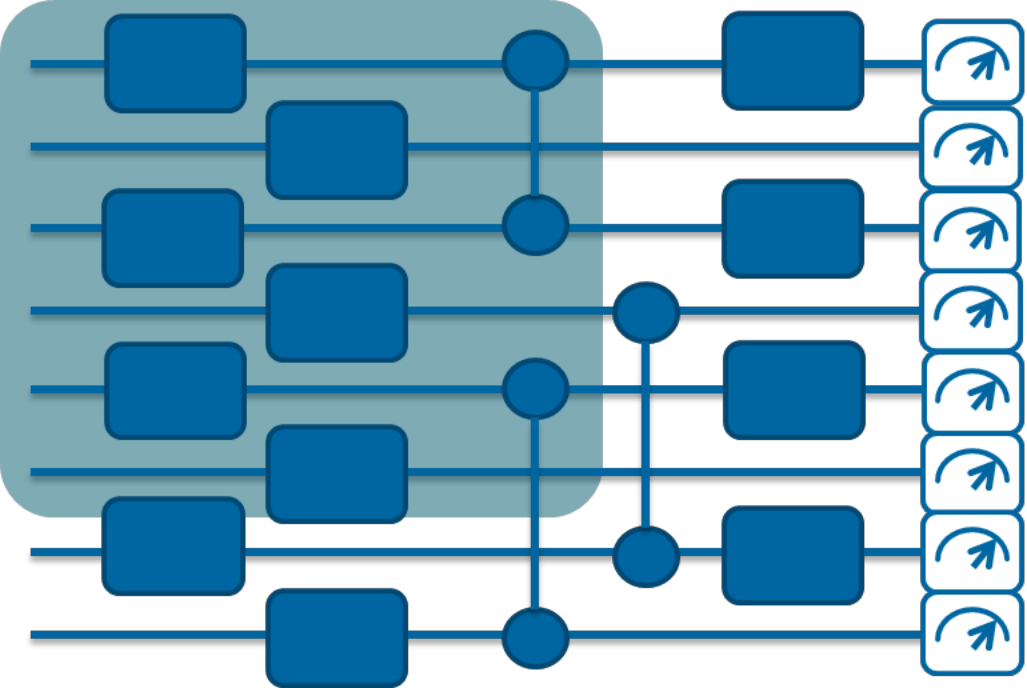
The goal of this course is to introduce the main concepts and challenges of quantum computing, a new set of technologies and techniques that promise to solve hard computational problems.
The aim of this lecture is to provide a description of quantum transport in disordered systems, with an emphasis on important phenomena like weak localization, Anderson localization and the Anderson metal-insulator transition. During the lecture, a number of important theoretical tools needed to describe quantum particle scattering in the presence of spatial disorder will be introduced in a pedagogical fashion, such as the Green's function technique, diagrammatic approaches to weak localization and transfer matrices. The lectures will be also illustrated by experimental examples and tutorials, especially taken from the physics of quantum gases and condensed matter.
Atoms and photons are the quantum probes that enable some of mankind’s most precise measurements.
Since the 80’s, laser cooling has enabled the production of sub-milliKelvin dilute atomic gases - which can be further cooled to the nanoKelvin regime.
The aim of this course is to present a selection of advanced topics in classical gravitational dynamics.
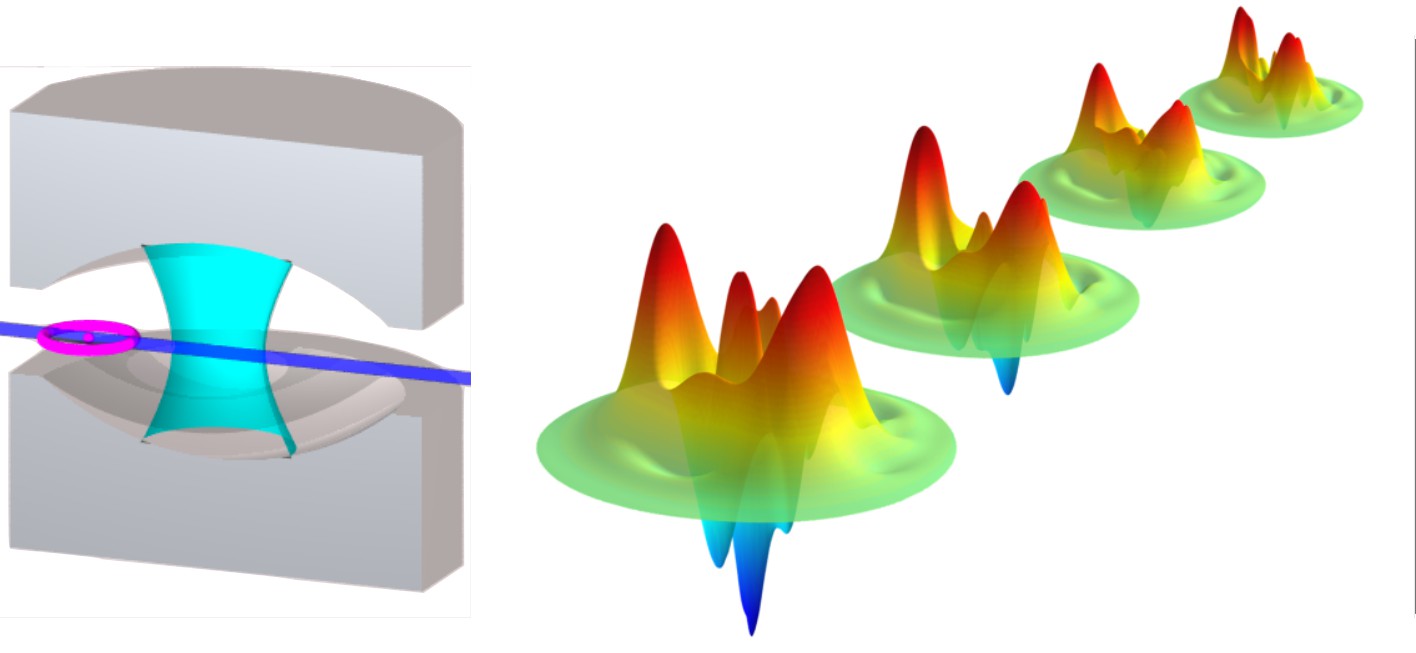
- This lecture aims at the description of the interaction between quantum matter in its simplest form, an atom, and an electromagnetic field. A semi-classical approach, where the field is classical, is first considered, including relaxation of the atom. We then study the quantization of the electromagnetic field and its relaxation, before its interaction with an atom is described in a full quantum model.