

- 601 results
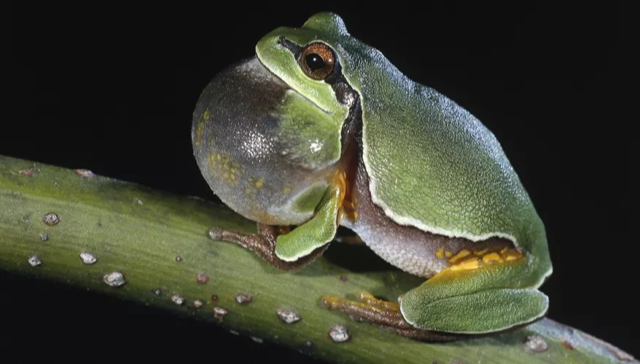
« La chétive pécore, s’enfla si bien qu’elle creva ». « Je plie, et ne romps pas ». While taking inspiration from the living, La Fontaine noticed examples of organisms – frog and reed – that deform strongly, sometimes beyond unrecoverable limits.
Turbulent flows are present all around us and are crucial in fields such as aeronautics, industry, meteorology, astrophysics, climate.
The development of animals, starting from a single cell to produce a fully formed organism, is a fascinating process. Its study is currently advancing at a rapid pace thanks to combined experimental and theoretical progress, with yet many fundamental questions remaining to be understood.
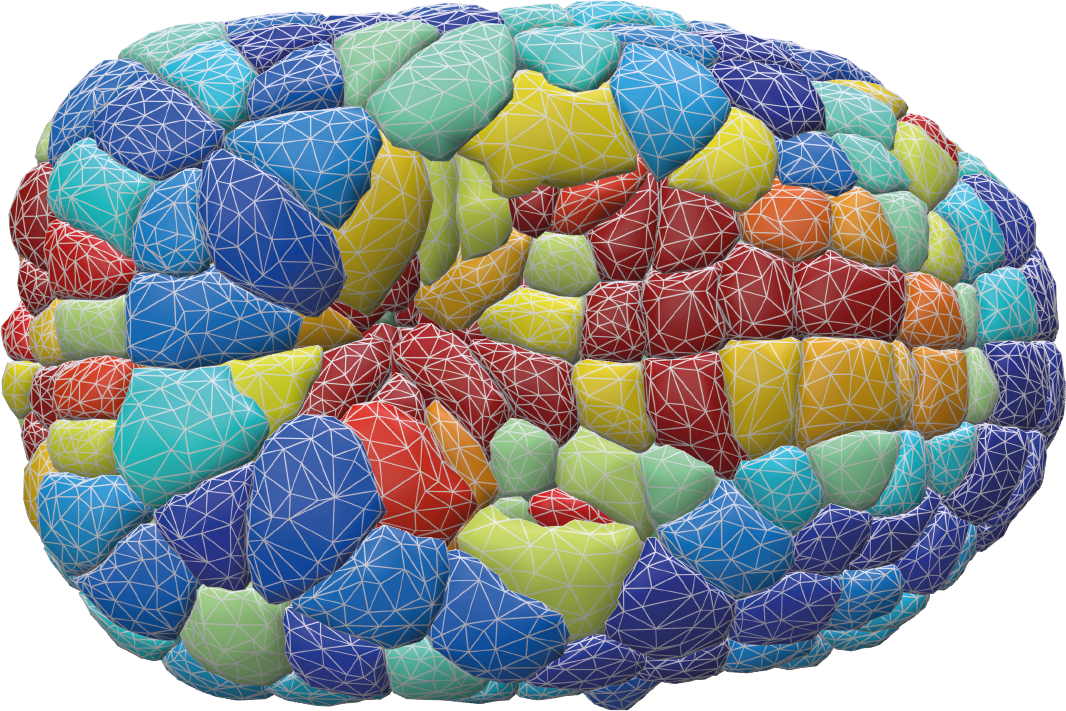
This course will address the fundamental theoretical concepts underlying the self-organization of multicellular systems, from genetic regulation to the mechanics of active biological materials. The course will be based on various concepts of theoretical physics: dynamical systems, soft an active matter, mechanics of continuous media, numerical modeling, etc.
In this course we will cover the basics of ecology, evolution, and epidemiology, with the lens and tools of physics.
The lectures offer a statistical-physics perspective on active matter, which encompasses systems whose fundamental constituents dissipate energy to exert forces on the environment. This out-of-equilibrium microscopic drive endows active systems with properties unmatched in passive ones. From molecular motors to bacteria and animals, active agents are found at all scales in nature. Over the past twenty years, physicists and chemists have also engineered synthetic active systems in the lab, by motorizing particles whose sizes range from nanometers to centimeters, hence paving the way towards the engineering of active materials.
The lectures will rely on the modern tools of statistical mechanics, from stochastic calculus to field theoretical methods, using both theoretical models and experimental systems to illustrate the rich physics of active matter.
Soft Matter refers to diverse materials such as polymers, colloids, granular materials or liquid crystals, that display complex features, as showing fluid or solid like properties depending on the external solicitation, anisotropic mechanical properties or the appearance of yield stresses
The Advanced Biophysics Course is a lecture course that covers modern concepts in experimental and theoretical physics of living systems, in the broadest sense.
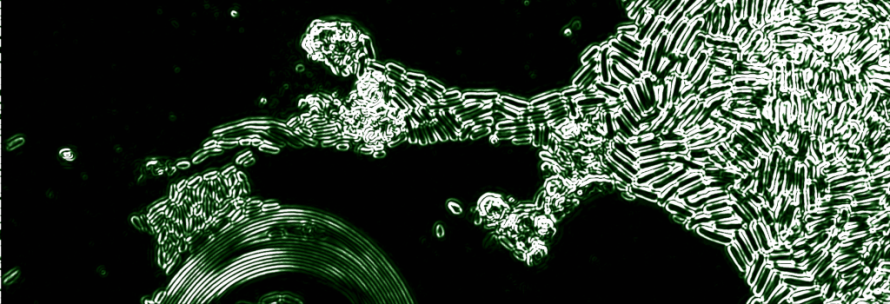
Image N. Desprat (LPENS)
Objectives : the lecture will present a broad overview of fluid mechanics at all scales, from bacterias to stars.
Physics is an experimental science. Its progress is due to a constant exchange between theory and experiments. Experimental skills are thus a requirement.
The aim of these seminars is to give a perspective about the role of fundamental science in solving societal problems and boosting industrial innovation. A vision on how quantum technologies are inspiring top-class physics research in the private sector will be the core of this teaching.